Free Summer Dress PDF Pattern (Size 44–52)
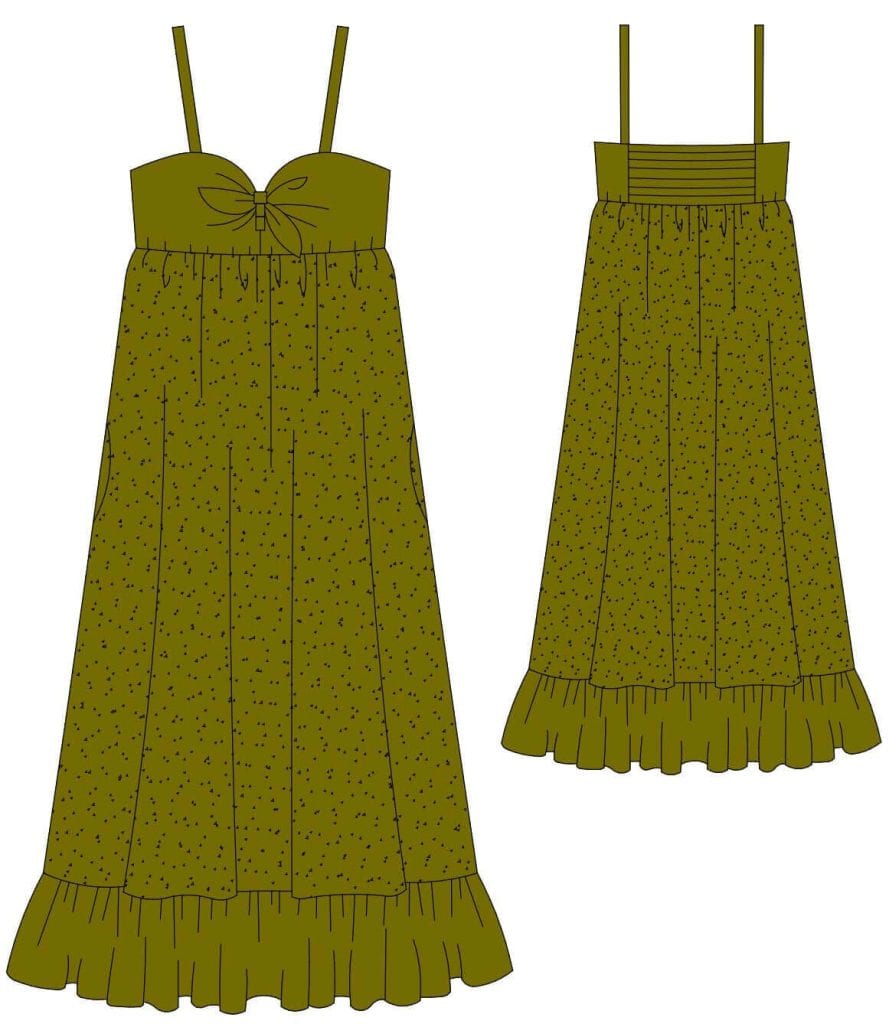
Light, breezy and designed for hot summer days – meet the Cherry Daze Dress, now available as a free PDF sewing pattern!
This summer dress is not only stylish but also incredibly comfortable to wear during the heat. The underbust-cut bodice creates a flattering silhouette, while the long, loose skirt flows freely for a breathable, airy feel. The ruffled hem adds a playful touch, and the shoulder straps offer a refreshing, open design.
The fitted bodice is gently gathered at the front for shaping and elasticated at the back for flexibility – no zippers or buttons needed! It’s shaped similarly to a bralette for comfort, while still feeling relaxed and summery.
What’s included in the free PDF?
the full sewing pattern (sizes 44–52),
the fabric requirements,
a complete size chart,
and a list of pattern pieces to cut.
Style Tip:
In this version, we combined polka dots with florals – but feel free to experiment! You can mix two different striped fabrics, or any other color-coordinated prints. This pattern is a great excuse to play with your fabric stash and let your creativity shine!
👇 Download the free pattern here:
Download it now and start creating something special!
Sewing Notes
Here are some essential tips for a successful sewing project:
Choosing the Right Size & Fit
- Always choose the size based on your body measurements, not your ready-to-wear size. Check the measurement chart included with the pattern.
- If adjustments are needed, make them before cutting the fabric. Lengthen or shorten the pattern by slashing and spreading or overlapping the pieces, securing with tape.
- For garments, check the ease allowance in the pattern. Some designs include negative ease (smaller than body measurements) for a snug fit, while others have extra room for comfort.
Fabric Recommendations
- Choose a fabric that matches the pattern’s suggested stretch percentage (e.g., 50% stretch means 10 cm fabric should stretch to 15 cm).
- Fabrics with poor recovery (not bouncing back after stretching) can result in wavy seams or a stretched-out garment. To prevent this, select a knit fabric with spandex/Lycra content.
- Preshrink your fabric by washing and drying it the same way you will care for the finished project.
Cutting & Preparation
- Iron your fabric before cutting to remove any creases. Use the correct heat setting based on the fiber content (low heat for synthetics, high heat for natural fibers).
- When placing pattern pieces, ensure the grainline is parallel to the fabric selvage to maintain the correct drape.
- Cut small, precise notches (about 1/8” or 0.3 cm) to avoid weakening the seam allowances.
Sewing & Finishing
- Use a stretch or ballpoint needle for knit fabrics to avoid skipped stitches. If stitches are skipping, try a slightly larger needle size.
- If seams appear wavy, try using a walking foot or adjusting the differential feed on an overlocker.
- Use a stretch stitch or zigzag stitch to maintain flexibility in the seams. If seams crack under stress, check the stitch type and use polyester thread instead of cotton.
- When pressing seams, lift the iron between sections instead of gliding it to prevent stretching out the fabric.
By following these guidelines, you’ll achieve a professional-looking finish and a well-fitting garment or accessory. Happy sewing! 🧵✂️

This Post Has 2 Comments
Super
Thank you